Shari Mari
Hi, I'm Shari

Shari — On The Record

We're in it together

I'm a mom, an entrepreneur, and someone who has spent her adult life translating complicated systems into practical next steps.

Shari — On The Record shares free, practical tools for organizing records, preparing for appointments and meetings, and navigating care, school, and support systems — alongside entrepreneurship, travel, and the real work of rebuilding when the original plan no longer fits.

Read my full story ↓
Start with these

Not sure where to begin? Try one of these three.

All free. Pick the one that matches what you're dealing with this week.

The Tracking Toolkit
Medications, visits, and diagnosis changes, all in one place.
Get the free toolkit →
Talking to Insurance About Residential Care
What to ask on every call, and a place to log each rep's name and reference number.
Open the call log →
What Goes in Your Binder
Which legal, medical, school, and insurance documents belong in your working binder.
Open the checklist →
See all the free toolkits ↓
My Story

We're still learning. And we're in it together.

I'm a mom and a 25-year entrepreneur — and some of the most useful things I've learned came from figuring out complicated systems the hard way.

Read my full story ↓Show less ↑

Long before Shari — On The Record, I grew up learning how quickly life can change. I was a military brat who lived overseas until I was 16, moving through different countries, schools, cultures, and versions of home. Military child life taught me adaptability, observation, cultural curiosity, and the complicated meaning of belonging — lessons that still shape how I parent, work, travel, communicate, and build community.

At 18, I became a mother and a university student at the same time. In 2004, I graduated from the University of Arizona in Tucson with dual bachelor's degrees: a B.A. in Linguistics, with minors in Language Development and Psychology, and a B.S. in Speech-Language Pathology, with a minor in Linguistics. That academic foundation in language, communication, child development, psychology, and speech-language systems still shows up in the way I research behavior, listen for what is not being said, and turn overwhelming information into language families can actually use.

I later married into the military and spent nine years as the wife of an enlisted U.S. Air Force service member, until his early retirement. Military spouse life added another education in relocation, uncertainty, service culture, family logistics, and the invisible labor required to keep a household functioning around a system much larger than any one family.

For more than 25 years, I've also helped build and operate a family-focused consumer brand. I've worked across nearly every part of the business: operations, product development, wholesale, retail, e-commerce, marketing, partnerships, customer care, technology, and the endless problem-solving that keeps a small company moving forward. I have built systems from scratch, figured out tools I was never formally taught to use, managed complicated projects, recovered from expensive mistakes, and learned how to keep creating when the path ahead was anything but clear.

But the education that changed me most did not happen in a boardroom, a classroom, or a business seminar.

It happened while parenting through crisis.

Families who find their way here are often navigating levels of care and intervention they never imagined they would face — emergency rooms, specialized treatment, insurance battles, endless phone calls, conflicting professional opinions, and the emotional reality of trying to advocate for someone they love when there are no simple or painless choices.

It often means learning an entirely new language while already overwhelmed. It means understanding that loving your child fiercely does not automatically give you access to the care, information, cooperation, or answers they need. It means becoming the person who keeps the records, asks the uncomfortable questions, reads the fine print, documents every conversation, and continues pushing after being told there is nothing else that can be done.

It often means carrying grief, hope, fear, anger, love, and responsibility at the same time.

Shari — On The Record exists because so many parents have said they could not find honest, practical conversations about what navigating these systems actually looks like. Too much of the available advice felt sanitized or theoretical. These resources are meant to meet families in the middle of it — organizing records, preparing for meetings and appointments, and handling insurance while still trying to get through one more day.

That need built a community.

The people who gather here include parents and caregivers, adult children, professionals who want to understand what these systems feel like from the family's side, and people who simply know what it is to love someone through circumstances they cannot fix.

Shari — On The Record is not about any one child, one diagnosis, or one family.

It is about what happens when real life becomes more complicated than the advice we were given.

It is about parenting without a reliable roadmap. It is about navigating institutions that were not designed to communicate with one another. It is about learning to advocate without losing yourself entirely. It is about military family life, relationships, resilience, work, identity, travel, faith, humor, failure, reinvention, and the strange ordinary moments that continue even when part of your life is in crisis.

Faith is part of that unfinished education too. Deconstructing faith has meant examining what I inherited, what I still believe, what no longer fits, and how to make room for uncertainty without surrendering compassion, meaning, or community. I do not have a neat conclusion for that process — only a commitment to asking honest questions and letting the answers evolve.

It is also about building something from what you have learned.

I believe difficult experiences can become useful without pretending they were necessary, beautiful, or secretly a blessing. We do not have to romanticize pain to recognize that it teaches us things. Sometimes the most meaningful thing we can do with hard-won knowledge is make it easier for the next person to find.

That is what I am building here.

Shari — On The Record is a place for honest stories, practical resources, printable guides, and conversations that leave room for complexity. You will find support for navigating crisis care and residential treatment, tools for organizing medical, behavioral health, and school information, questions to ask professionals, lessons from entrepreneurship, e-commerce, brand building, and creator platform development, and pieces of everyday life that remind us we are more than the hardest thing happening to us.

I am not here as a clinician, attorney, or person claiming to have every answer. I am here as a mother, an operator, a researcher, a relentless note-taker, and someone who has spent years learning how to ask better questions.

You will find what families commonly say helps, what often does not, what they wish they had known earlier, and where you may need qualified professional guidance.

You do not need to have any particular story to belong here.

Maybe you are facing your first crisis and do not know what to do next. Maybe you have been doing this for years and are exhausted from explaining your life to people who cannot understand it. Maybe you are building a business, raising a family, questioning your faith, starting over, or trying to turn your own experience into something that helps others.

Whatever brought you here, you do not have to arrive with everything figured out.

We are still learning.
And we are in it together.

xx Shari
Find Me Everywhere

Follow along

The main conversation happens on TikTok, but Shari — On The Record lives across a few other places too.

Resources · Start Here

Support, crisis lines, and real-world help

This resource hub is one of the most important parts of Shari — On The Record. These are practical directories, crisis services, support organizations, and parent communities you can reach for when you need information, help, or another person who understands.

Why these resources? Every organization on this list is one I've called myself, used myself, or seen recommended again and again by other families living this same reality. I'm not affiliated with any of them — I just don't want you to have to spend a 2am Google spiral finding a starting point I could have handed you directly.

xx Shari
Visit NAMI → Find local help → Connect with RAINN → Open Childhelp → Browse the directory → Open the provider list →
Coming Soon

More resources are on the way

This list keeps growing — more crisis lines, directories, and community resources are being added. Know of one that should be here? Email hello@sharimari.com and I'll consider adding it.

Free Toolkits & Printable Tools

Practical support you can actually use

Real, hard-won tools for the parts of parenting, advocacy, mental health care, residential treatment, and family crisis nobody hands you a manual for — plus a few good-practice tools that are useful for any parent or caregiver, no diagnosis or crisis required. They're grouped below in roughly the order families actually need them — start with how to use the tools, then school and caregiver communication, then diagnosis and daily tracking, then escalation to residential care and insurance. Nine are live now, with more free toolkits on the way.

@shari.ontherecord

These tools were built from the questions and gaps parents raise again and again: the forms nobody hands you, the records nobody keeps in one place, and the checklists families say they wish they had at the very beginning — when you don't yet know what you don't know.

Everything here is free, organized, and meant to help you walk into the next appointment, meeting, or intake better prepared. No one has to do this alone — we are in it together.

xx Shari

Start Tracking Your Records Now
Free · Guide
Three Ways to Use These Tools
Desktop for long-term planning and reflection, your phone's home screen for on-the-go access in the moment, and paper for appointments and history you keep together. How to set up each one, plus how to save your tools to a "CASE FILES" folder on your phone.
See how to set it up →
Free · Editable · Reusable
The Tracking Toolkit
Medication, visits, and diagnosis changes — one place to keep it all, whether you're just starting or years in. Built around the details care teams ask for most, so you don't have to memorize any of it.
Get the free toolkit →
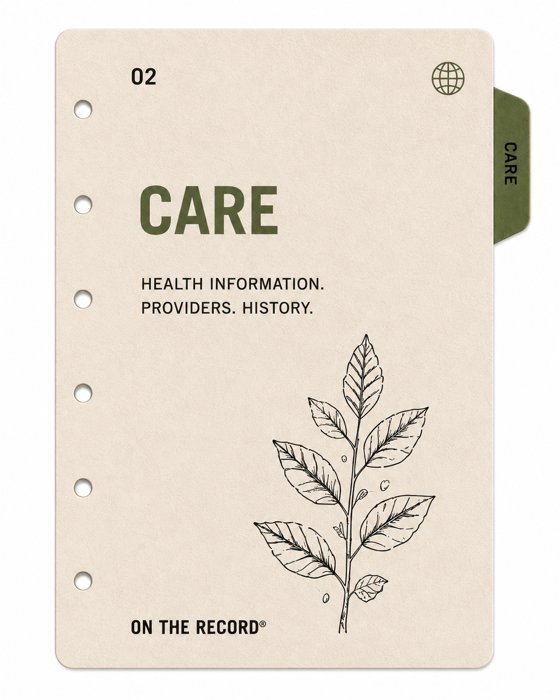
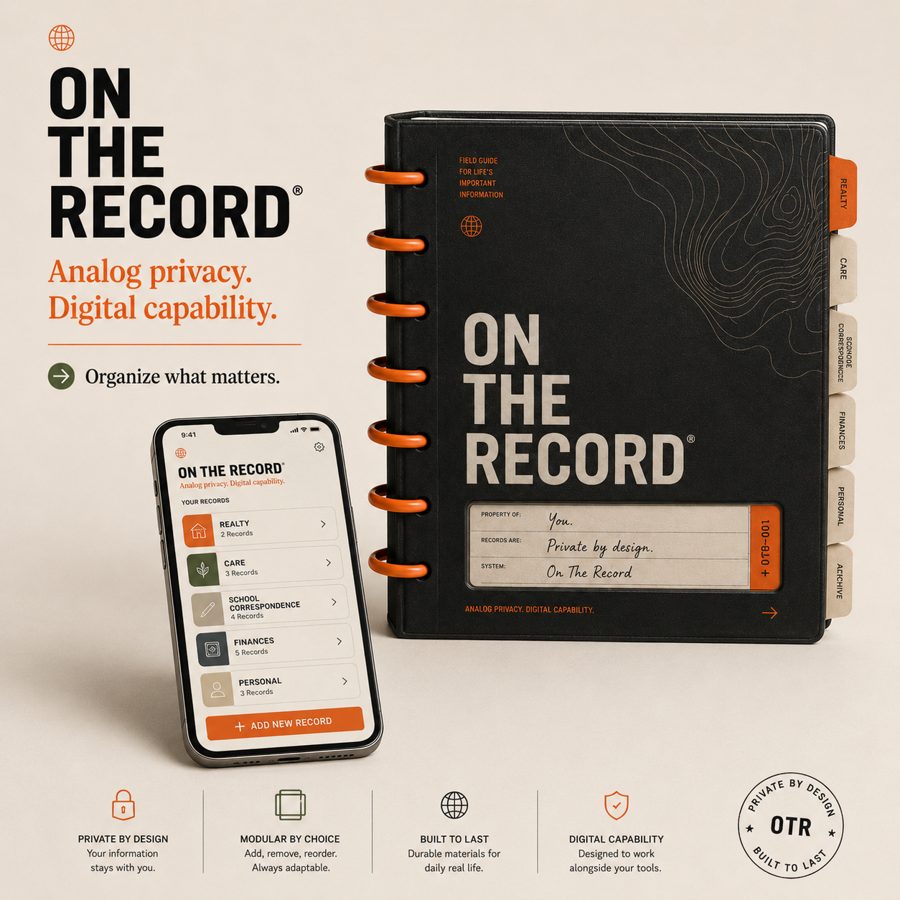
On The Record 'Care' divider card — health information, providers, history
School & Caregiver Resources — For Any Parent
Free · Interactive · Printable · Reusable
Student Support Snapshot
This isn't just for crisis or diagnosis — it's a good practice for any parent or caregiver, at any stage, even before a diagnosis is ever on the table. Create a strengths-based “About Me” profile that helps a teacher, babysitter, coach, grandparent, or anyone caring for your child actually get to know them — how they communicate, what helps, what to watch for. Save the editable form data to your computer, update it as things change, then print or save a dated PDF and email the current version to whoever needs it.
Learn about the free form →
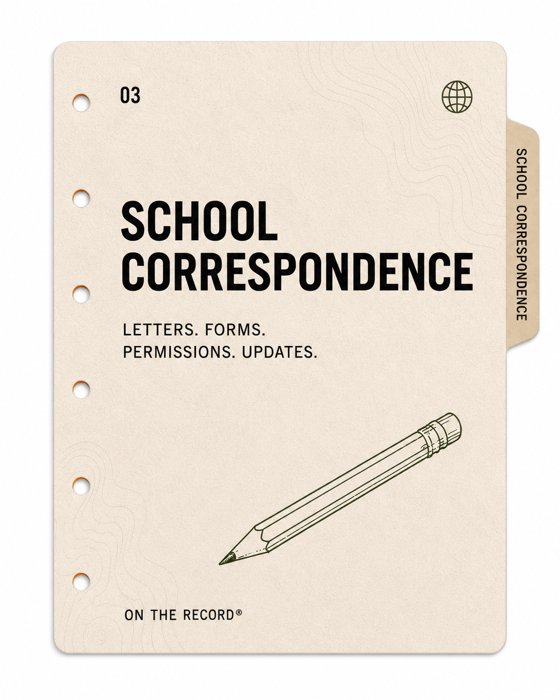
On The Record 'School Correspondence' divider card — letters, forms, permissions, updates
Diagnosis, Medication & Appointments
Free · Fillable · Save Per Visit
Questions to Ask Your Doctor
The questions that are easy to forget when you're standing in the room — check them off, edit them to fit your situation, add your own, and record the answers. Save one checklist per visit.
Open the checklist →
Free · Editable · Case Files Only
What Goes in Your Binder
You are now a case — insurance, medical, special education. No one else keeps the records straight. This checklist covers exactly which legal, medical, school, and insurance documents belong in your working binder, and which ones stay in the fire safe instead.
Open the checklist →
Escalation to Residential Care & Insurance
Free · Fillable · Save Per Facility
How to Choose a Residential Center
The categories that separate a good fit from a bad one, the non-obvious questions that don't show up on a tour, and a place to build your contact list before you need it. Save one worksheet per facility you're considering.
Open the worksheet →
Free · Fillable · Save Per Facility
Questions to Ask Before Any Placement
Ten categories covering licensing, safety practices, staffing, family access, education, medication, discharge planning, cost, and identity/access needs — check off what you've asked, record the answer, and save one entry per facility to compare.
Open the checklist →
Free · Fillable · Save Per Call
Talking to Insurance About Residential Care
What to ask on every call, a place to log the rep's name and reference number every time, and what to ask if the answer is a denial. Save one entry per call.
Open the call log →
On The Record 'Finances' divider card
Free · Fillable · One Per Placement
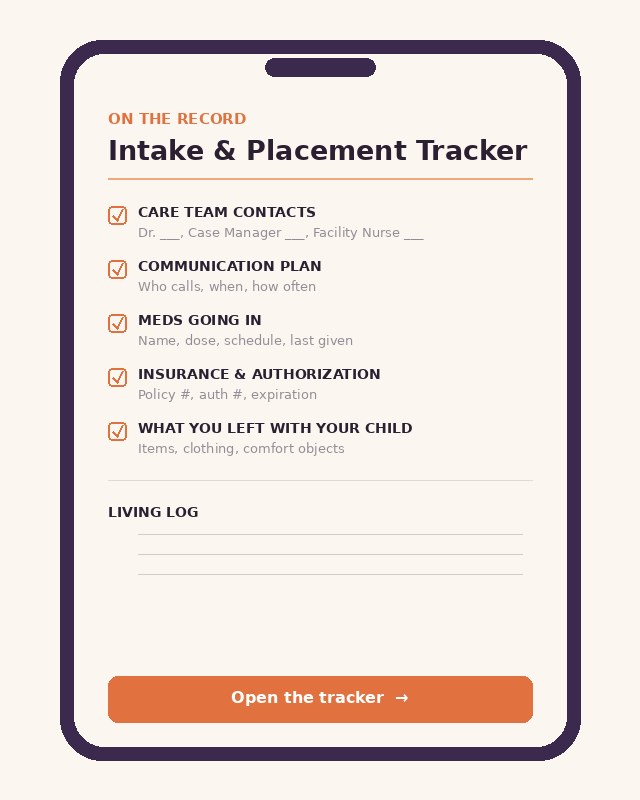
The Intake & Placement Tracker
Pull it up on your phone before you even walk in: care team contacts, communication plan, meds going in, insurance and authorization info, what you left with your child, and a living log to track every update after. Save one entry per placement.
Open the tracker →
Preview of the Intake & Placement Tracker form
Toolkit · Coming Soon
Crisis & Escalation Guides
The first ER visit, the "admit today" conversation, and the moments that feel like there's no roadmap.
For Professionals
For Professionals · Coming Soon
For Care Teams
A curriculum and practical tips for clinicians, nurses, and case managers — how to make tracking and compliance easier for the families you work with, and how to bridge the gap between care-team frustrations and what families actually need.

Have a request, or want to know the second new tools go live?

Email me directly at hello@sharimari.com — if there's a guide or toolkit you wish existed, tell me and I'll help create it. Or just drop your email below and you'll be the first to hear when each new one is ready — no spam, just the good stuff.

Get In Touch

Contact

Work with me

Press, partnerships, collaborations, coaching questions, or just to say hi — it all comes to the same place. Reach out directly:

hello@sharimari.com (209) 231-3939